
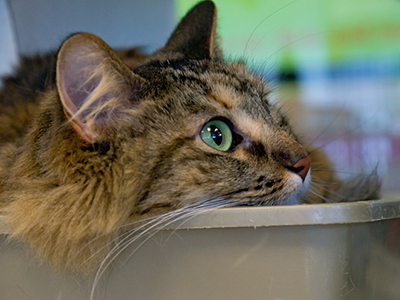
 Top 10 Reasons Your Cat Might Have Stopped Using its Litterbox
Following is a general list of reasons cats stop using their litterbox. Please note that cats may use their litterbox for years and then stop using it for no apparent reason. Most likely there IS a reason they have stopped, and to fix the problem, you will need to figure out what the reason is.
It is possible that your cat has been using the litterbox for years, and all of a sudden decided that whatever they didn’t like about their litterbox was just too much to take one more time.
The good news is most litterbox problems can be fixed and your cat will be back to using its litterbox immediately.
1. Medical problem. Cats may stop using their litterbox due to a medical problem, such as a urinary tract infection (UTI). Medical reasons may make it uncomfortable for a cat to use its litterbox, and because the cat may have felt pain from a medical condition while using the litterbox, the cat may associate the litterbox with the pain. If your cat has litterbox problems, the first thing to do is take your cat to your veterinarian to rule out a medical issue.
2. Poor location of litterbox. Cats tend to like quiet, private places to use the bathroom. They may not like their litterbox next to a noisy hot water heater or by the washer and dryer. Try adding a litterbox in a quieter place and see if your cat starts using that box. Remember to never place an adult cat that’s having litterbox problems into a litterbox. It can make them think the litterbox is a punishment. Instead, let your cat see you setting up the new box and let them discover the new box on their own.
Cats may also have issues if they feel their litterbox is located in an area that has no escape route. This tends to occur in busy households or ones where there are multiple cats, dogs, or children. Try putting your cat’s litterbox in a corner where they can have their back to the wall. This allows them to use their box while being able to see anything that might be coming.
3. Unclean box. Not only is a cat’s sense of smell many times sharper than ours, their noses are 20 times closer to a smell’s source. Cats would like their boxes cleaned every time they use it, but realistically it’s ideal to clean it once a day, or at a minimum thoroughly clean it once a week (even if you use scoopable litter). When thoroughly cleaning the box, not use bleach or another strong-smelling cleaning agent or this could cause your cat to shy away from it. Instead, use hot, soapy water.
4. Litter choice. If your cat was using its litterbox and then you decided to change the litter to something “better,” you may have a problem. It’s good to remember the old saying, “If it ain’t broke, don’t fix it.” If your cat is using its litterbox, don’t switch the litter. If you have switched the litter from what the cat is used to, this could be why your cat has stopped using the litterbox. Try switching back to your original cat litter to see if this fixes the problem. It’s also important to understand that many cats do not like litters with perfumes or additives for smell. Some cats with “litter aversion syndrome” can even stop using their litterbox because they don’t like the feel of a harder type of litter. Scoopable litter can be used to give your cat something softer to go to the bathroom on. To see if this is something that is an issue for your cat, add another litterbox with scoopable litter in it next to the cat’s original box and see which box your cat chooses to use. Note: If for some reason you HAVE to switch cat litters you should gradually mix the new litter type you are switching to with the litter that the cat has had over a period of time – gradually increasing the amount of the new litter vs. the old litter, until you are 100% to the new litter.
5. Box size. The litterbox you choose for your cat needs to be shallow enough that a cat can climb into it (pay special attention to this if you have a kitten or an older cat with arthritis). A litterbox also needs to grow in size with your cat. If you have a large cat, a plastic, under-the-bed storage unit can be used as a litterbox.
6. Privacy issues. Cats are evolutionary programmed to follow an elimination ritual to cover their scent to protect them from predators. This calls for peace and quiet. Avoid placing your cat’s litterbox in a high-traffic area, but also, avoid placing the box in a dark area or tight closet area. Cats need to be able to easily get into their litterboxes.
Covered litterboxes can also be a huge problem for some cats. First, they tend to keep the smell more confined right in the area your cat is going to the bathroom. Second, they can stress out cats that have “escape route” issues (explained in #2 above). Take the cover off the litterbox and see if this solves your problem.
7. Litterbox count. You should have at least one litterbox per cat in the household. In some circumstances, you will need two litterboxes per cat (some cats won’t urinate and defecate in the same box). If you have two cats and only one litterbox, add a litterbox next to the original box. Both cats may end up using both litterboxes, but they will each have a box.
8. Switching location. Moving the box from location to location can be a problem for a cat. Find a place both you and your cat like, and stick with it.
9. Invaded territory. If a cat is in the litterbox and a second cat (or dog, or child) in the household confronts it while it is in the box, the cat may start to avoid the box to avoid the confrontation. In addition, if your cat can see another cat outside through a window or door, this may cause the cat stress because it feels its territory is being invaded. Typically when this happens you’ll see spraying (vs. urination), and if that is the case you will need to deal with the territory and spraying issues to solve the problem. Again, as discussed above, having no “escape route” can be an issue for some cats because they may feel their territory is being invaded.
10. Punishment strategies. Cats do NOT do things out of anger. They are trying to communicate there is a problem. If you punish your cat when it doesn’t use its litterbox, you have added to the stress your cat is already feeling and instead of stopping the problem, you may have just accelerated the problem. NEVER punish your cat when he doesn’t use the litterbox (or for any other reason). Only use positive methods and positive reinforcement to solve a litterbox problem.
In addition:
- Never rub cats’ noses in their accidents! Not only is this not going to solve the problem, it will make it worse. It’s also completely unhealthy for your cat.
- Never physically place them into the litterbox thinking you are sending the signal to use the box. In actuality, this will cause the cat to think it isn’t supposed to use the box because the box is someplace where he gets punished.
- The use of squirt bottles is not recommended because it is difficult to use a squirt bottle and not be seen by the cat.
- Confinement also doesn’t necessarily solve litterbox problems long term because you haven’t addressed why your cat quit using the litterbox in the first place. Confinement may work in the short term because the confinement area may be so small your cat doesn’t have a choice not to use the box, but long term we need to solve the problem of why your cat quit using his litterbox so your cat can live out and about your house as a member of the family.
- Never take an indoor cat and put them outside to be an outside cat because of a litterbox problem. Indoor cats should be indoor cats and should stay that way. You need to work to solve the litterbox problem for your cat.
Myths
It is important to note that cats do not quit using their litterbox to “get back at their guardians.” A cat may even urinate on the floor right in front of their guardians, or urinate on their guardian’s bed but the cat is only going in these places to indicate to their guardian that there’s a problem, because they can’t help it, or because the surface they are going on is softer than their litterbox. Cats also do not quit using their litterbox because they are “jealous” of another pet, a new baby, etc.
Spraying
Spraying is a separate issue from regular litterbox issues. Spraying is usually (but not always) due to territory issues. Here are a few things you can do to solve spraying issues:
- Close all the curtains/drapes in your house for a period of time so your cat can’t see outside, and thus, can’t see other cats walking around their yard (their territory).
- Use Feliway by and around the windows/doors that your cat is spraying around. Feliway is a spray that contains cat pheromones that help stressed cats relax. You can get Feliway at pet supply stores or by ordering it online.
- Talk to your neighbors and ask them to keep their cats in their houses so they aren’t wandering into your yard where your cat can see them.
If you need help, please call the ARL’s Cat Behavior Helpline at (515) 262-9503, ext. 312.