 The best way to train your pet is through the proper use of positive reinforcement/rewards. You need to understand when and how to use them and what will happen if they are improperly used. With training, you want your pet to “learn” the desired task and/or behavior.
What is positive reinforcement?
Positive reinforcement is anything that increases the likelihood that a behavior will be repeated. There is a positive relationship between behavior and consequence. The more the pet does a behavior, the more consequences it gets, and what it gets is good. This makes the behavior increase.
What kinds of things will a dog consider positive reinforcement?
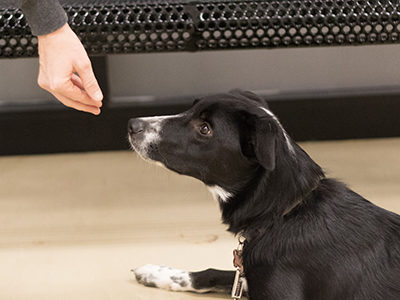
They will differ from dog to dog. For some, it may be a pat on the head, a play session, a fun toy, a walk, or a food treat. The key is to select the reward that motivates your pet. It can be useful to feed your dog, depending on its age, at one or two scheduled meal times. Training sessions can then be performed just before meal time when the dog is at its hungriest. Most puppies can then be motivated with pieces of food. In the same way, toys, play sessions, and affection can be reduced until training time so that the dog is “hungrier” for these rewards.
Some of the dogs that are hardest to train are those that are difficult to motivate. These dogs may do better with a few special treats that are saved specifically for training sessions (e.g,. sausage slices, small morsels of chees), or pieces of dog food sprinkled with flavoring such as powdered cheese. By the way, if there’s no good reason to give your dog a treat, don’t – it fills him or her up, and accomplishes nothing. Consider these tidbits and biscuits not as treats but as “training rewards”. If these rewards are saved for training, they are more motivating, and the pet will learn to associate the rewards with the desired behavior. Whenever you are giving the dog something of value, from food to a walk, first give your dog a command so that each reward can be earned.
How do I properly use positive reinforcement?
The proper use of positive reinforcement is more than just giving a treat or a pat on the head. The timing of the reinforcement is very important. Remember, your pet is behaving all the time. So, you need to be sure to reinforce the behavior that you want and not some other behavior. Therefore, closely associate the reinforcement with the behavior you wish to increase.
Reinforcement must immediately follow the behavior; any longer and you run the risk of the pet engaging in another behavior while you are administering the reinforcement. A good example of this is when you teach a dog to sit. You tell your dog to sit, and manipulate her into the position. While you are saying “good dog” and giving a food treat, the dog stands up. What has just happened? You have rewarded sitting and standing up.
Should I reward my pet every time?
The frequency of reinforcement is important. The rate at which behavior is reinforced is called the “schedule”. There are several different schedules of reinforcement.
- Continuous reinforcement. Every time your pet engages in a behavior it is reinforced with a reward. While this may sound like a good idea, it is actually less than ideal. If you reward a behavior continuously, once you cease rewarding the behavior, it will often stop.
- Ratio or variable rate of reinforcement. The reinforcement does not come after each performance of the behavior but intermittently. This may mean that instead of a reward every time, the pet gets a reward 2 every third time, then perhaps two in a row, then maybe not until the pet has performed the behavior five more times. What happens if you reward this way? Behavior tends to be stronger and last longer.
- Start training new commands or tasks with continuous reinforcement, but then switch to intermittent, variable rates as soon as your pet is responding consistently.
What if my rewards are not working?
First, you may not be reinforcing the correct task. Remember the example of sitting and standing up. Be sure that the timing of your reinforcement is correct, and immediately after the behavior you wish to increase. Second, you may be phasing out your reinforcement before your pet has adequately learned the new behavior. Go back to basics and be sure your pet understands what to do. Lastly, you may be repeating commands several times, or in a different way, and thus confusing your pet. Ask for our handouts on training for specific tasks for additional help.
What type of rewards should I use?
Rewards do not always have to be food. For many pets, owner attention can be a reward as can a walk in the park or a game of fetch. What is important is that it be appropriate and motivating for your pet. Remember, you need not give a “special” reward such as food each time your pet performs a task, but always acknowledge good behavior if only with praise or affection.
Is there a wrong way to reward my dog?
Yes. We may reinforce behaviors that we do not want. Remember, positive reinforcement makes behavior increase. So, there may be times when you think you are punishing your dog when you are indeed reinforcing behaviors. Examples include scolding your dog in a friendly tone of voice or petting your dog after it jumps up on you, even though you do not like jumping. Giving any form of attention to a barking dog, a dog that is jumping up, or a dog scratching at the back door only serves to reward the behaviour. Sometimes people even give a bit of food, the dog or play with it in an attempt to calm it down. What they are doing, however, is reinforcing the problem behaviour. What is worse is that when these behaviours are rewarded occasionally or intermittently, the behaviour becomes stronger and lasts longer (see above). A reward should always be earned.
Are rewards only used for training?
There are other situations where rewards can be most helpful. For example, it may help a puppy or even an adult dog to learn to accept new people if that greeting is always coupled with a food treat. This will help the pet learn that new people bring something good. In other cases, rewards can be used to encourage desirable behavior. Food-enhanced toys may encourage a dog to chew on them instead of household possessions.